0.033
Mean sentiment score
Syuzhet lexicon score across all 1,132 comments in this group. A near-zero average does not mean every comment is neutral.
A computational reception study · Yue Xing
Mapping audience emotion in YouTube comments on Chinese dramas
How do viewers respond to emotionally intense, formula-driven stories? This project reads English-language comments through words, emoji, and machine-assisted emotion labels, asking what each approach makes visible.
01 / The dataset
The study compares comments on Chinese short-form and long-form dramas across female-oriented (女频) and male-oriented (男频) genre categories. These describe industrial categories of content, not the gender of individual viewers.
On YouTube, the short-form dramas in this sample appear as full compilations; the long-form series appear as individual episodes. “Short-form” refers to the drama’s narrative format, rather than the duration of the uploaded video.
| Drama format | Female-oriented | Male-oriented |
|---|---|---|
| Short-form | 4,687 comments · 15 videos | 1,132 comments · 15 videos |
| Long-form | 8,830 comments · 3 series | 2,034 comments · 3 series |
Collected in May 2026 using the YouTube Data API v3. English-language filtering was applied before analysis. The corpus is a selected sample of public comments, not a representative survey of viewers.
02 / Emotion explorer
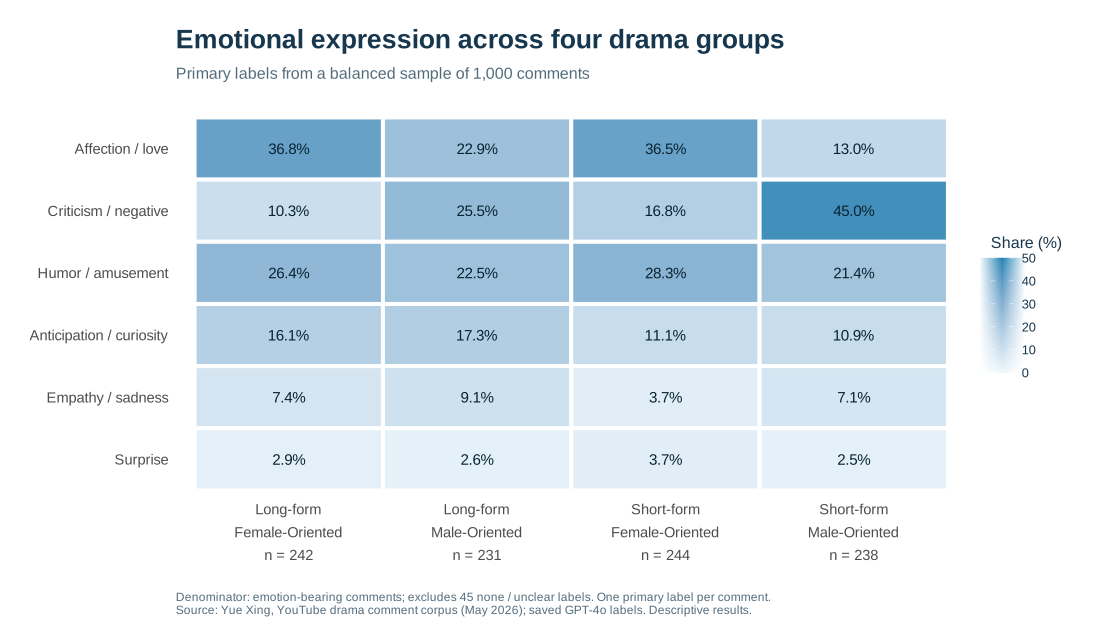
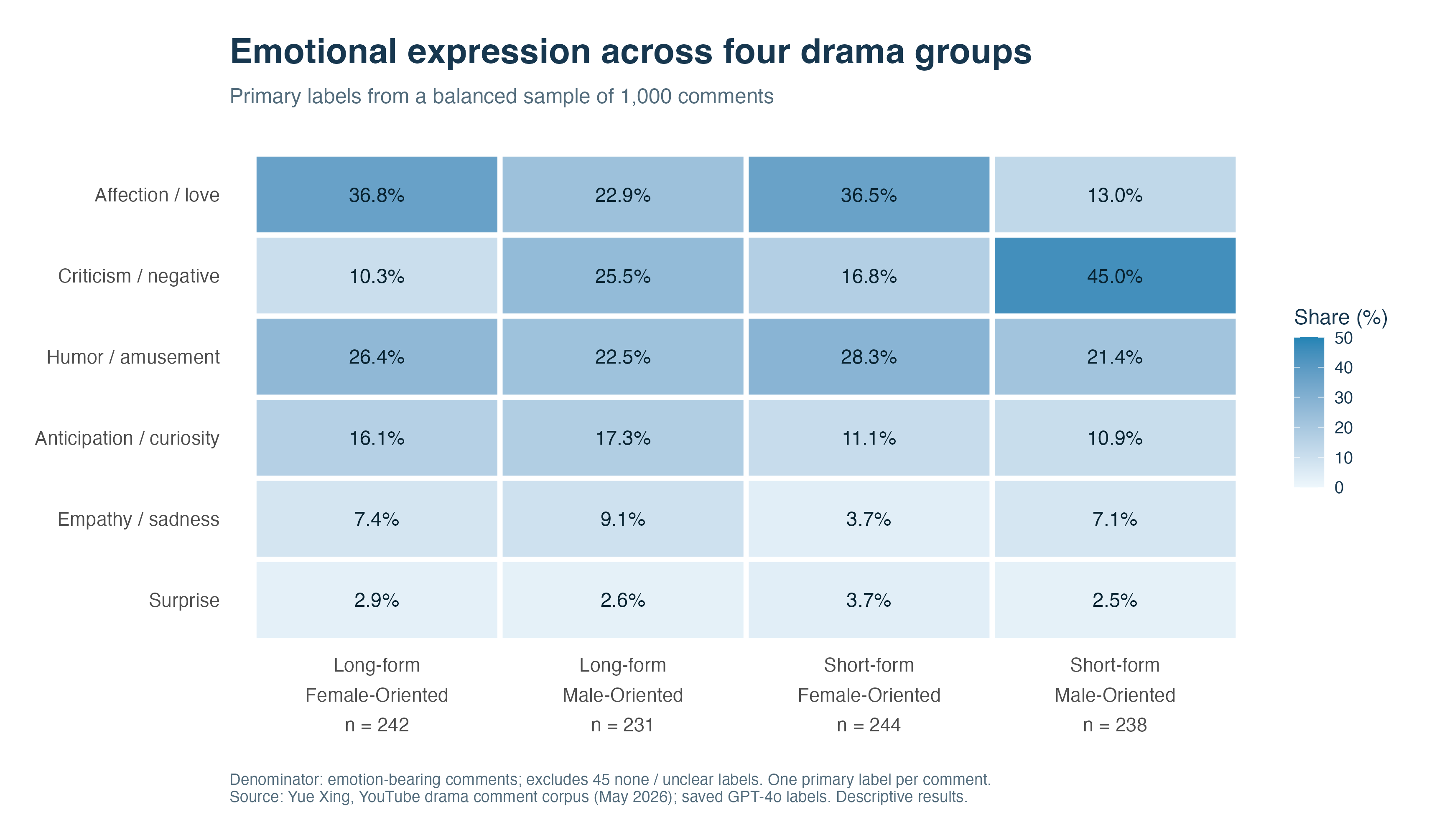
Affection is prominent in female-oriented drama comments in the labeled sample. Critical and negative evaluations are especially prominent in male-oriented short-drama comments. Explore how the distribution changes across groups.
03 / Emoji explorer
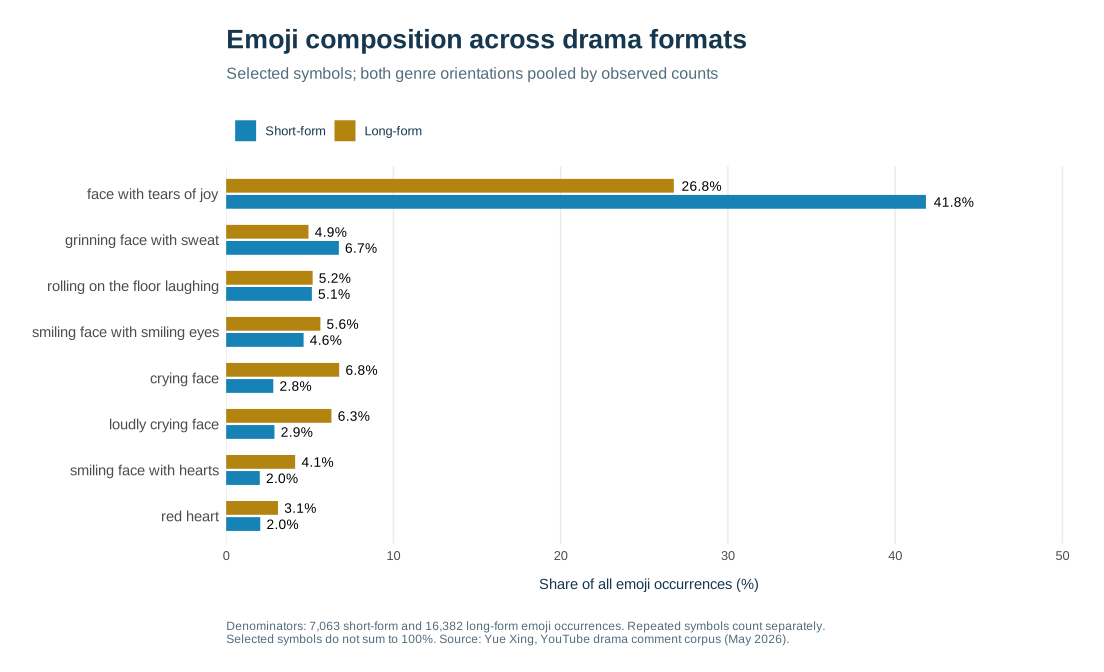
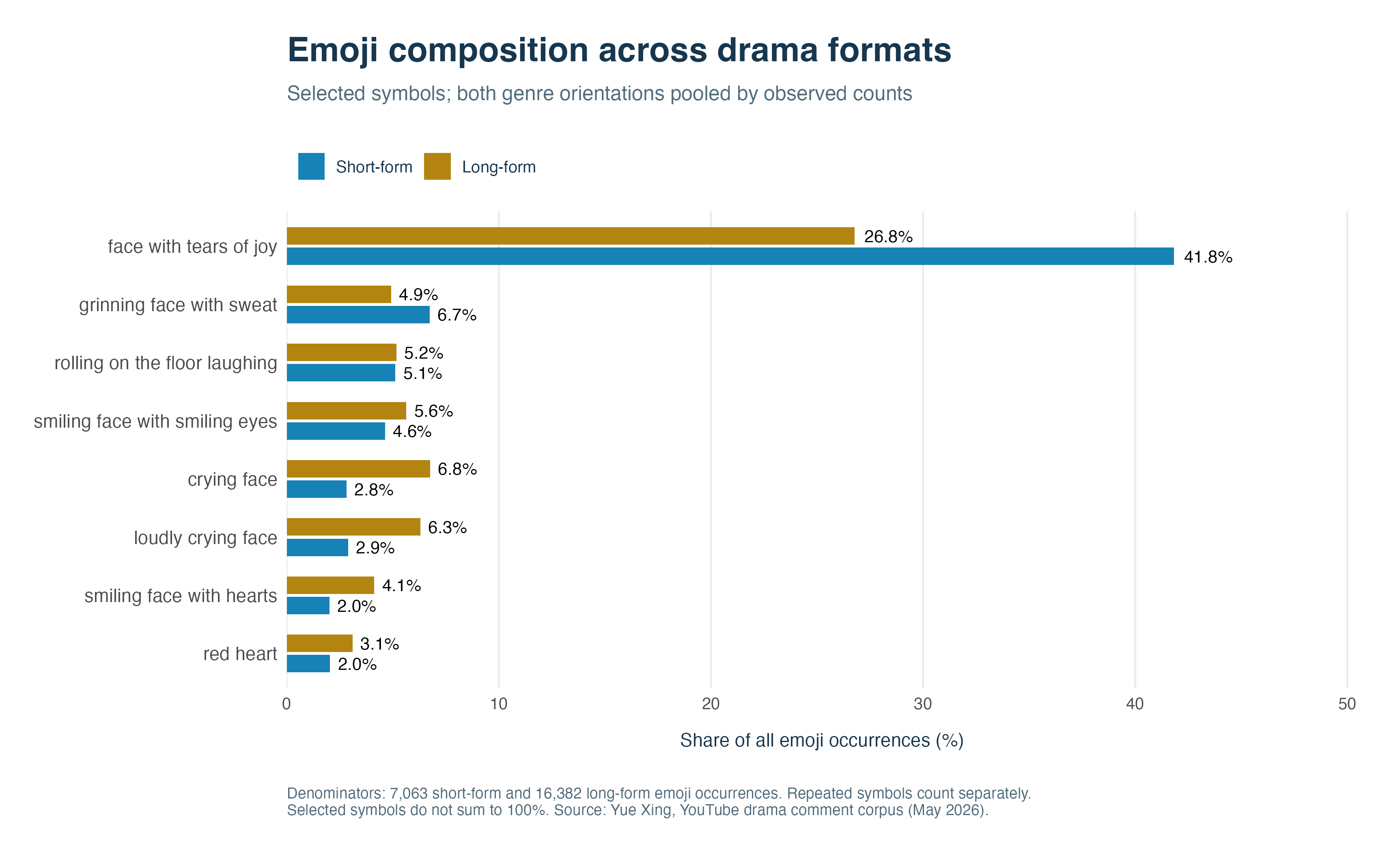
Long-form comments in this corpus more often contain emoji (50.1%) than short-form comments (40.1%). Yet the tears-of-joy face accounts for a larger share of emoji occurrences in short-form comments (41.8%, versus 26.8% in long-form comments). Frequency of use and composition tell different parts of the story.
Share of all emoji occurrences in the selected group · fixed 0–50% scale
04 / Reading methods together
Male-oriented short-drama comments offer a useful case. A near-zero average lexicon score, a concentration of laughing emoji, and frequent critical labels coexist at the group level. Each method measures something different.
Syuzhet lexicon score across all 1,132 comments in this group. A near-zero average does not mean every comment is neutral.
571 of 1,280 emoji occurrences. Repeated symbols count separately; this is not a percentage of commenters.
107 of 238 emotion-bearing comments in the LLM sample. Based on the primary label, with unclear cases excluded.
I use distanced laughter as an interpretive lens for engagement that can involve amusement alongside recognition and criticism of narrative formulas. These aggregate measures motivate closer reading; they do not by themselves establish that laughter and criticism occur in the same comment.
The project treats differences between computational methods as a starting point for interpretation. An emoji’s conventional name, a sentiment score, and an LLM label each capture a partial view of audience expression.
05 / Methods & scope
Thirty short-drama videos were selected from DramaTime and Dragon King Drama, with 15 videos per genre orientation. Six long-form series, three per orientation, were selected from Tencent Video. Up to 500 top-level comments per video were retrieved using relevance order; replies were excluded. The cld3 language detector retained English-language comments. The supplied cleaned corpus contains 16,683 unique comment IDs and no missing comment text.
A stratified sample of 250 comments per group was drawn from comments containing at least three whitespace-separated tokens. GPT-4o (gpt-4o-2024-08-06, temperature 0) assigned one primary emotion and an optional secondary emotion using seven categories consolidated after an exploratory coding stage. This site displays the saved labels; it does not rerun a model when you use the controls. “Emotion-bearing” excludes none_unclear labels.
Emoji were extracted using the R emoji package, with modifiers normalized before counting. Emoji shares use all emoji occurrences in each selected group as the denominator, including repeated symbols. Emoji comment rates use all comments as the denominator. Syuzhet assigns lexicon-based sentiment scores to comment text. The site presents descriptive comparisons.
The sample is limited to English-language comments on selected YouTube videos. Genre orientation is confounded with channel in the short-form sample. Compilations and individual episodes also provide different contexts for commenting. Comments are self-selected, relevance-ranked, and clustered within videos and series; percentages are descriptive and do not establish causal effects or represent all viewers.
LLM labels are interpretive and may miss irony, mixed affect, and context. Emoji semantics depend on use. Neither method gives direct access to a viewer’s feelings, nationality, or gender.
The public dataset contains one row per comment with derived numeric features, group labels, and saved LLM labels where available. It omits comment text, platform IDs, user IDs, timestamps, and verbatim model rationales. Local observation and content IDs support analysis without linking directly to YouTube comments. This reduces direct traceability but is not a guarantee of anonymity.
The downloadable tables reproduce the displayed distributions. Text-based scores cannot be recomputed from the public feature release alone. The documentation describes the original inputs, transformations, denominators, and exclusions.
06 / Take a closer look
Download the public feature dataset and the tables behind the figures. Files use UTF-8 encoding. Release: September 21, 2026.
Suggested citation: Xing, Yue. 2026. Distanced Laughter: Audience Emotion in YouTube Drama Comments. Public feature dataset and visualizations, September 21 release. Related paper: Mapping Audience Emotion in YouTube Short-Form Drama Comments: A Multi-Method Computational Reception Study.