0.033
Dictionary sentiment
Mean Syuzhet score across 1,132 comments.
MCAA 2026 · October 4 · Session 6, Panel 26
Mapping Audience Emotion in YouTube Short-Form Drama Comments through Multi-Method Computational Analysis
Yue Xing · University of Illinois Urbana–Champaign
Media, Technology, and Cultural Representation in East Asia
Slides 3–6 / The starting question
Intense stories can invite reactions that mix criticism with amusement.
This talk asks what emotional expressions appear in short-drama comments, how they compare with longer dramas, and what different analytical approaches reveal. The section numbers above match the slides, so you can jump directly to the evidence being discussed.
Taking popular audiences seriously means looking closely at the expressions they choose to make public. Computation reveals patterns across comments; individual readings help interpret those patterns.
Slides 2–7 / Research design
The study compares comments on Chinese short-form and long-form dramas across female-oriented (女频) and male-oriented (男频) genre categories. These describe industrial categories of content, not the gender of individual viewers.
On YouTube, the short-form dramas in this sample appear as full compilations; the long-form series appear as individual episodes. “Short-form” refers to the drama’s narrative format, rather than the duration of the uploaded video.
| Drama format | Female-oriented | Male-oriented |
|---|---|---|
| Short-form | 4,687 comments · 15 videos | 1,132 comments · 15 videos |
| Long-form | 8,830 comments · 3 series | 2,034 comments · 3 series |
Collected in May 2026 using the YouTube Data API v3. English-language filtering was applied before analysis. The corpus is a selected sample of public comments, not a representative survey of viewers.
Slide 8 / Step 1
A classifier asks whether a comment comes from a short drama or a longer series. Selected words retained after vocabulary filtering point toward recognizable story formulas and different ways of discussing a series.
trope · reborn · faked · twin
Recognition of recurring plot devices offers a starting point for interpreting audience engagement.
episodes · relatable · soul · hearts
These examples invite closer reading of how viewers discuss serialized stories and their characters.
Selected examples from the final manually filtered model. Coefficients indicate association in this classifier, not word frequency or the emotional meaning of every comment.
The final format classifier performs 10.4 percentage points above its baseline; the genre classifier performs 2.9 points above baseline. These are improvements over baselines, not overall accuracy values.
Slide 9 / Step 2
The Syuzhet dictionary assigns scores from emotional vocabulary. Male-oriented short-drama comments have an average close to zero. That result leaves the mixture of expression unresolved.
| Content group | Mean | Median | Comments |
|---|---|---|---|
| Long / female-oriented | 0.734 | 0.50 | 8,830 |
| Long / male-oriented | 0.398 | 0.35 | 2,034 |
| Short / female-oriented | 0.688 | 0.50 | 4,687 |
| Short / male-oriented | 0.033 | 0.00 | 1,132 |
A score near zero can reflect mixed language or limited dictionary coverage. It does not establish that viewers felt nothing. These scores are not percentages or measures of emotional intensity.
Slide 10 + discussion slide 15 / Step 3
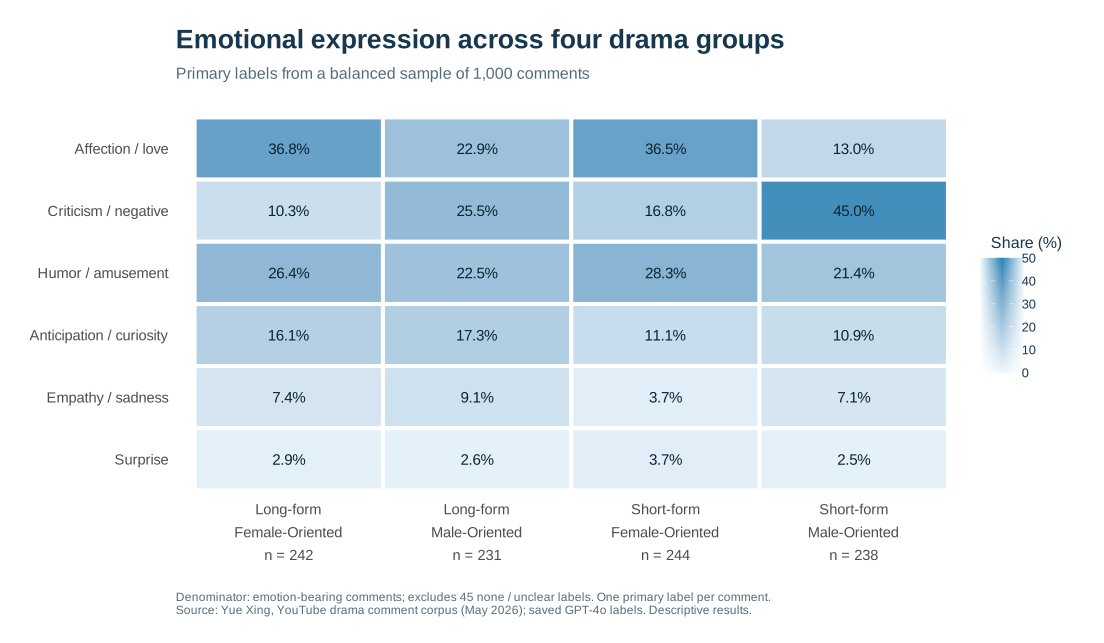
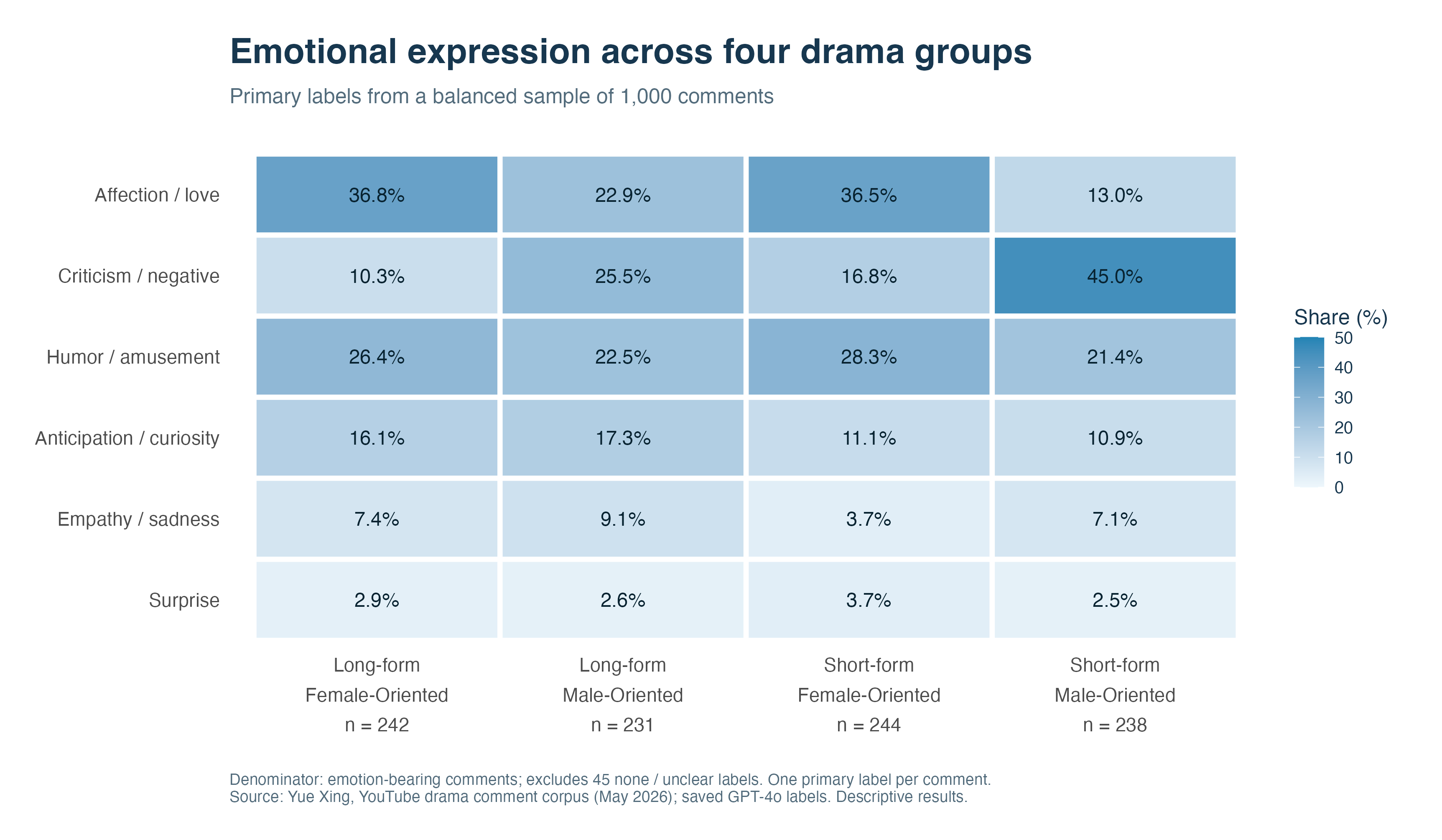
Affection is prominent in female-oriented drama comments in the labeled sample. Critical and negative evaluations are especially prominent in male-oriented short-drama comments. Humor appears across all four groups. Tap a cell for its count, or use the filters to compare groups.
Slide 11 / Step 4
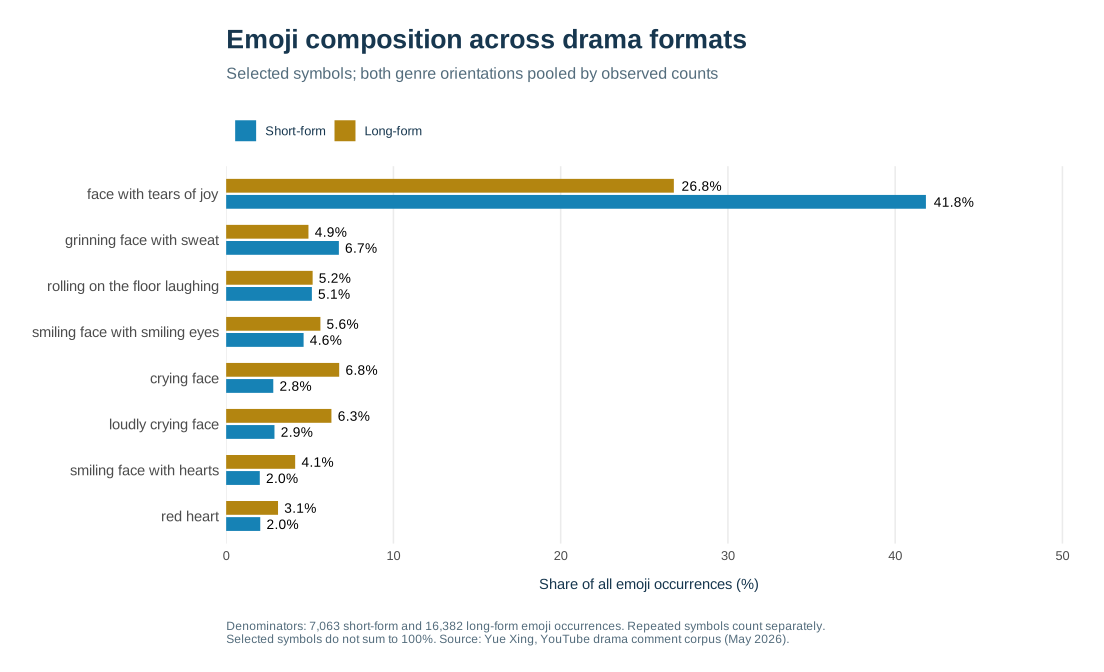
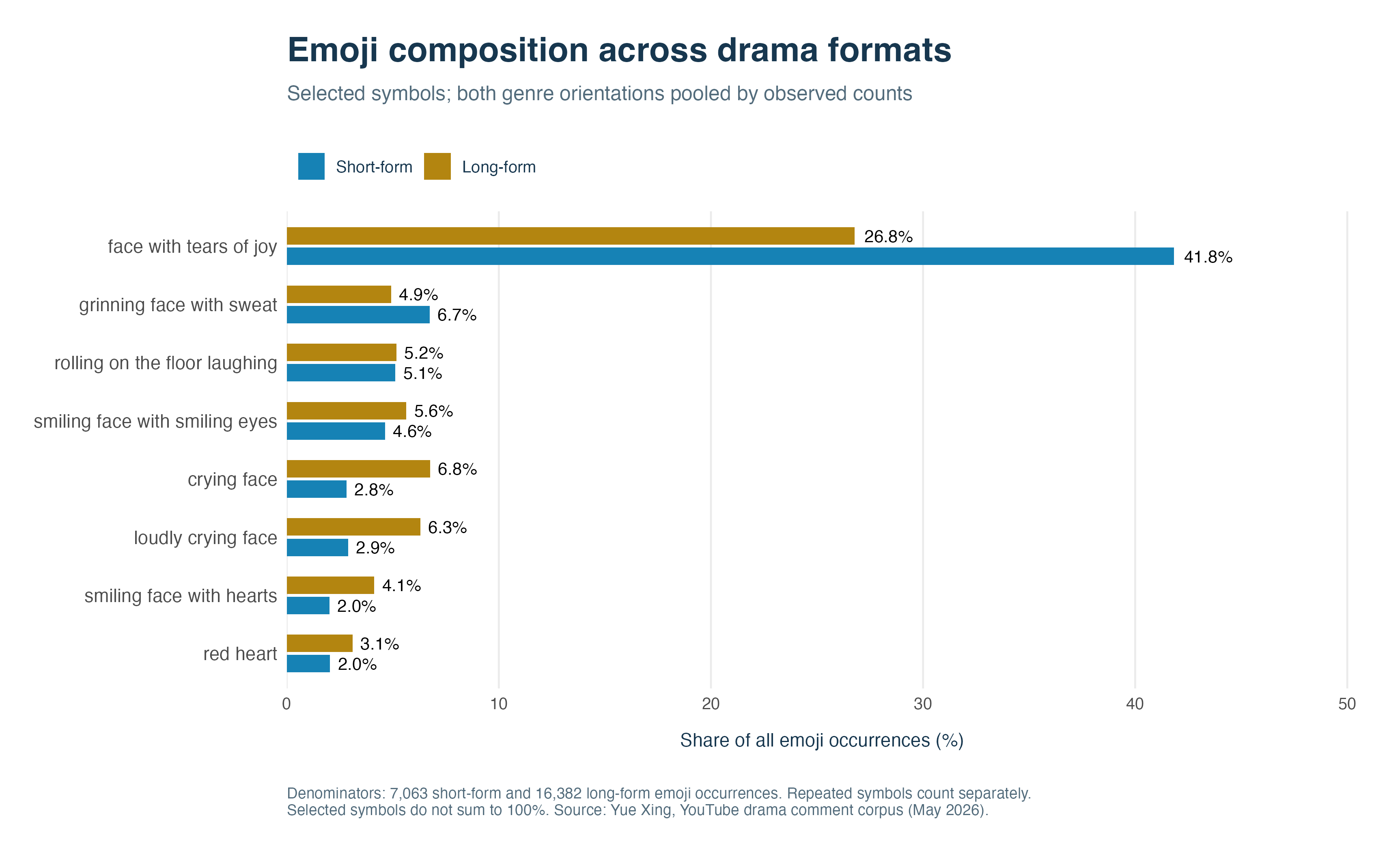
Long-form comments in this corpus more often contain emoji (50.1%) than short-form comments (40.1%). Yet the tears-of-joy face accounts for a larger share of emoji occurrences in short-form comments (41.8%, versus 26.8% in long-form comments). Frequency of use and composition tell different parts of the story.
| Measure | Short-form | Long-form |
|---|---|---|
| Comments containing emoji | 40.1% | 50.1% |
| Average emoji per comment | 1.21 | 1.51 |
| 😂 share of all emoji occurrences | 41.8% | 26.8% |
More than half: 😂, 😅 and 🤣 together account for 3,793 of 7,063 emoji occurrences in short-form comments (53.7%). The slide reports 53.6%; this page calculates the combined share from the downloadable counts.
Share of all emoji occurrences in the selected group · fixed 0–50% scale
Slides 12–13 / Reading the evidence together
Enjoyment can coexist with recognition and criticism of narrative formulas.
The male-oriented short-drama group brings the methods into focus. The results below describe the same content group using different units of analysis.
Mean Syuzhet score across 1,132 comments.
107 of 238 emotion-bearing comments in the labeled sample.
571 of 1,280 emoji occurrences, including repeated symbols.
The comment discussed on slides 3 and 12
A viewer complains that a moment lasting only seconds has been stretched into fifty minutes, and ends with 😅😋.
Paraphrase of the presentation example, from a female-oriented short drama. It illustrates mixed expression; it is separate from the male-oriented group summarized above.
I use distanced laughter to describe a mode of enjoyment accompanied by critical recognition of narrative formulas. This interpretation draws together vocabulary, aggregate patterns, and close reading. The group-level percentages alone cannot show that criticism and laughter occur in the same comment.
Return to the emotion explorer ↑Slide 14 + discussion
It can express several things. A laughing face becomes interpretable alongside words, narrative context, and individual examples. The symbol alone does not establish mockery or distance.
People who posted English-language top-level comments on selected YouTube videos. Comment language does not establish a viewer’s nationality, location, or gender. Silent viewers are outside this evidence.
Yes. Channels and stories differ, and short dramas appear as compilations while longer series appear episode by episode. These comparisons describe associations rather than isolating the effect of format.
They are one interpretive aid. The model reads the whole comment, including emoji, and can miss irony or mixed expression. Comparing methods and reading examples helps clarify what a label captures.
Discussion slide 16 reports 55 label changes in a 100-comment emoji-removal check. The supplied package includes the procedure but not the resulting comparison file, so that result is reported from the presentation and is not independently reproduced in the downloadable data. Label changes after changing an input do not by themselves establish model error.
Closer reading, interviews, and comparisons across platforms and languages can help clarify what viewers mean when they laugh and how widely this stance travels.
After the talk
The public release provides derived features and saved emotion labels. It omits raw comment text and platform identifiers. Download the notes for variable definitions, denominators, and the limits of reproducibility.
About the presenter
I am a PhD student in East Asian Languages and Cultures at the University of Illinois Urbana–Champaign, originally from Harbin, China, with a B.A. and M.A. from Fudan University.
My research examines Chinese popular literature and culture, with particular attention to feeling, narrative, and changing media forms. This project brings those interests into conversation with digital humanities and audience reception.
yxing16@illinois.edu